
McKinsey has just published a matrix that's making the rounds: six “customer experience” workflows where agentic AI delivers the most impact with the best feasibility. Two axes: feasibility, and the value at stake, expressed as a percentage of revenue or margin.
The chart is well made. It's useful. And that's exactly why it's a trap.
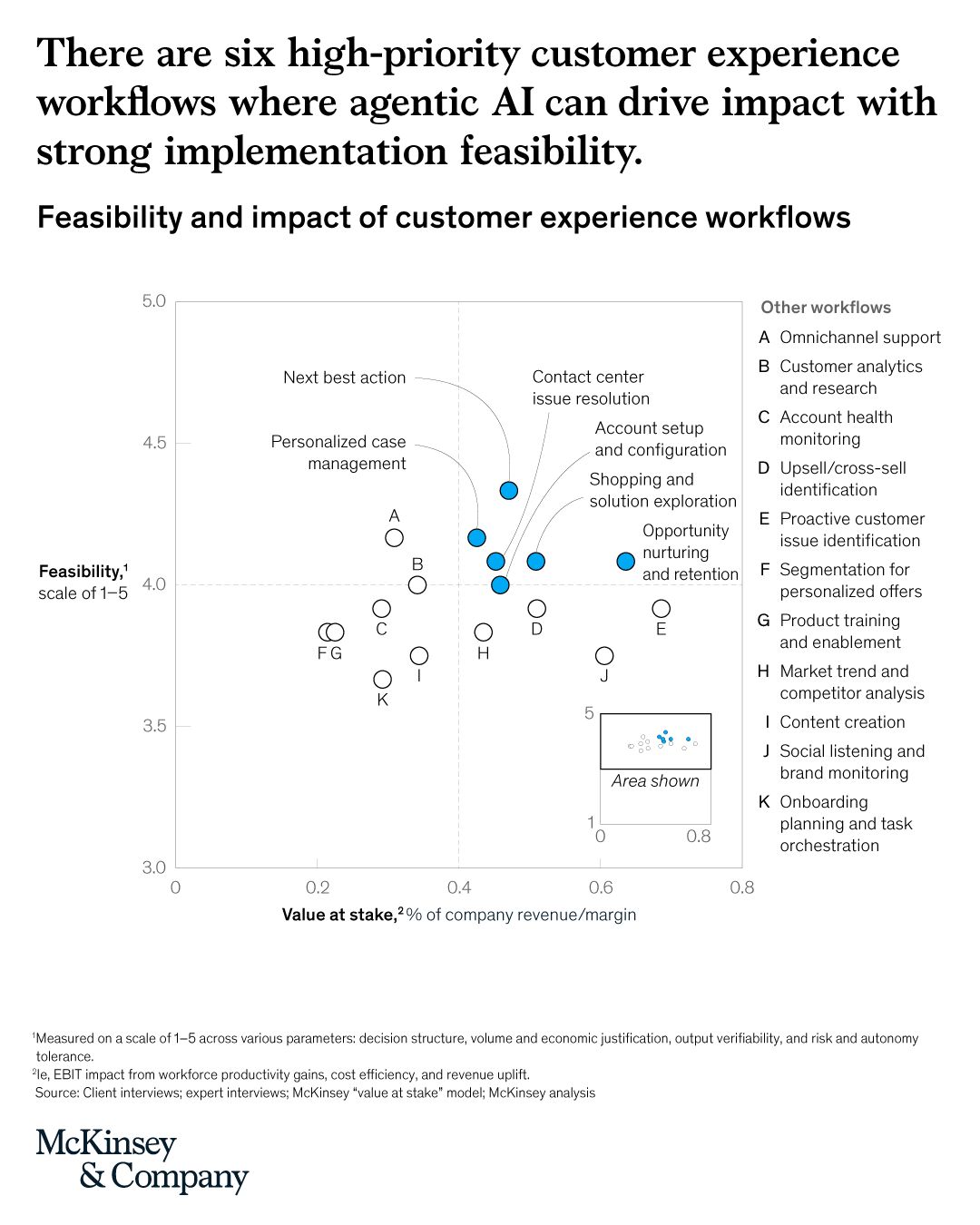
Customer experience: what the two axes don't measure
Because if you look at it for two minutes, you notice something missing. On those two axes, the customer doesn't exist. What's measured is the value captured by the company through automating the customer relationship. The customer isn't the subject of the graph — they're its object. That's consistent: it's a tool built for finance departments. But it means the framework is structurally blind to what actually makes a customer stay: the friction you spare them, the pleasure you give them, the contact you create with them.
And here's where you have to be clear-eyed. When human contact costs almost nothing to produce, two companies do two opposite things. The first removes the human that has become “useless”: the customer falls into a tunnel of agents. The second reallocates the human to where they create relational value, and lets AI absorb the friction. Same technology. Opposite strategies. A customer can perfectly well be served faster and worse at the same time — and no KPI on McKinsey's matrix will ever catch it.
Over-optimisation: the real trap isn't automating badly, it's automating too well
There's a second, deeper omission in this kind of reasoning. The matrix rewards optimisation: automate as many interactions as possible, capture as much value per interaction as possible. That's the right instinct… in stable times.
But we're not in stable times.
An over-optimised process is a fragile process. It's tuned to the millimetre for a given context, so it breaks the moment the context shifts. And when you pour that optimisation into code, integrations and autonomous-agent rules, you don't just create efficiency: you create hardened rigidity. A manual over-optimised process can be cleared away — humans work around it, improvise, adapt. An automated over-optimised process has to be dismantled. That's far longer, far more expensive, and often no one fully understands anymore why it does what it does.
It's the ocean-liner syndrome. The great transformations that never reach port — not because they're badly steered, but because the port has moved between departure and arrival. Today, what matters is no longer over-optimisation. It's robustness, agility, the ability to handle imperfection. AI is a tremendous opportunity for adaptation. Poorly thought through, it's a dead end you can't get out of.
Continuity of state: the real challenge isn't orchestration
Here's what most projects miss. Automating each interaction, one by one, is the easy step — it's what the chart shows. The real problem isn't wiring workflows together. It's connecting the state produced by one decision to the next decision.
Every interaction changes something. A recommendation is accepted or rejected. New information appears. A human steps in. An unexpected outcome invalidates the assumptions behind the previous action. If the next agent doesn't inherit what has changed, you've connected your workflows technically — but your organisation keeps deciding as if nothing had happened. It has amnesia between every decision.
The customer declines an offer on Monday. On Thursday, another agent proposes it again, word for word. Technically, everything works. Humanly, you've just told them you're not listening.
A truly agentic system doesn't call for more automation. It calls for continuity: of state, of evidence, of authority, and of learning, across the whole journey. So the most valuable system isn't the one that automates the most interactions. It's the one where every meaningful outcome can, responsibly, change what the organisation and its agents are allowed to do next.
Resistance to change: people or machines?
We keep saying people are the brake on transformation. I believe the opposite.
People resist, yes — but they can change their mind in a single conversation. The machine doesn't resist: it executes. The problem is the system you've built around it. That's what becomes inert, illegible, impossible to move. The real resistance to change, in the end, isn't your teams. It's the technical architecture you froze in place thinking you'd save time.
In other words: the human is the agile component of your system. The most adaptable one. The one that handles imperfection with no pre-set plan.
So before rushing towards the six boxes on the chart, ask yourself three questions the matrix doesn't. Where does AI reduce friction for the customer, not just cost for you? What does each interaction teach your organisation — and where does that learning go? And the person you free up: are you moving them to where they create contact, or removing them from where they still created it?
Automating a lot makes you efficient. And fragile. Automating so that every outcome changes what the system is allowed to do next makes you adaptable. In today's climate, that's not the same strategy. It's not even the same job.