A Belgian professional services firm with ten years of content and enterprise references, stuck on page 4 of Google just as buyers started asking AI which firm to hire. We rebuilt on its existing equity and added a GEO programme: exposure in Google's AI answers multiplied by 18, a top 10 place on 84% of the prompts buyers use to shortlist a provider, and AI search now the first source of new inbound opportunities. Early results, a few months in, and still improving.
A few months into the programme, an established B2B firm has moved from page 4 of Google to page 1, gets cited in AI answers on the very questions its buyers ask before choosing a provider, and receives leads that come straight from ChatGPT and AI search. The work is ongoing, and results keep improving. Here is how, without throwing away ten years of SEO equity.
At a glance
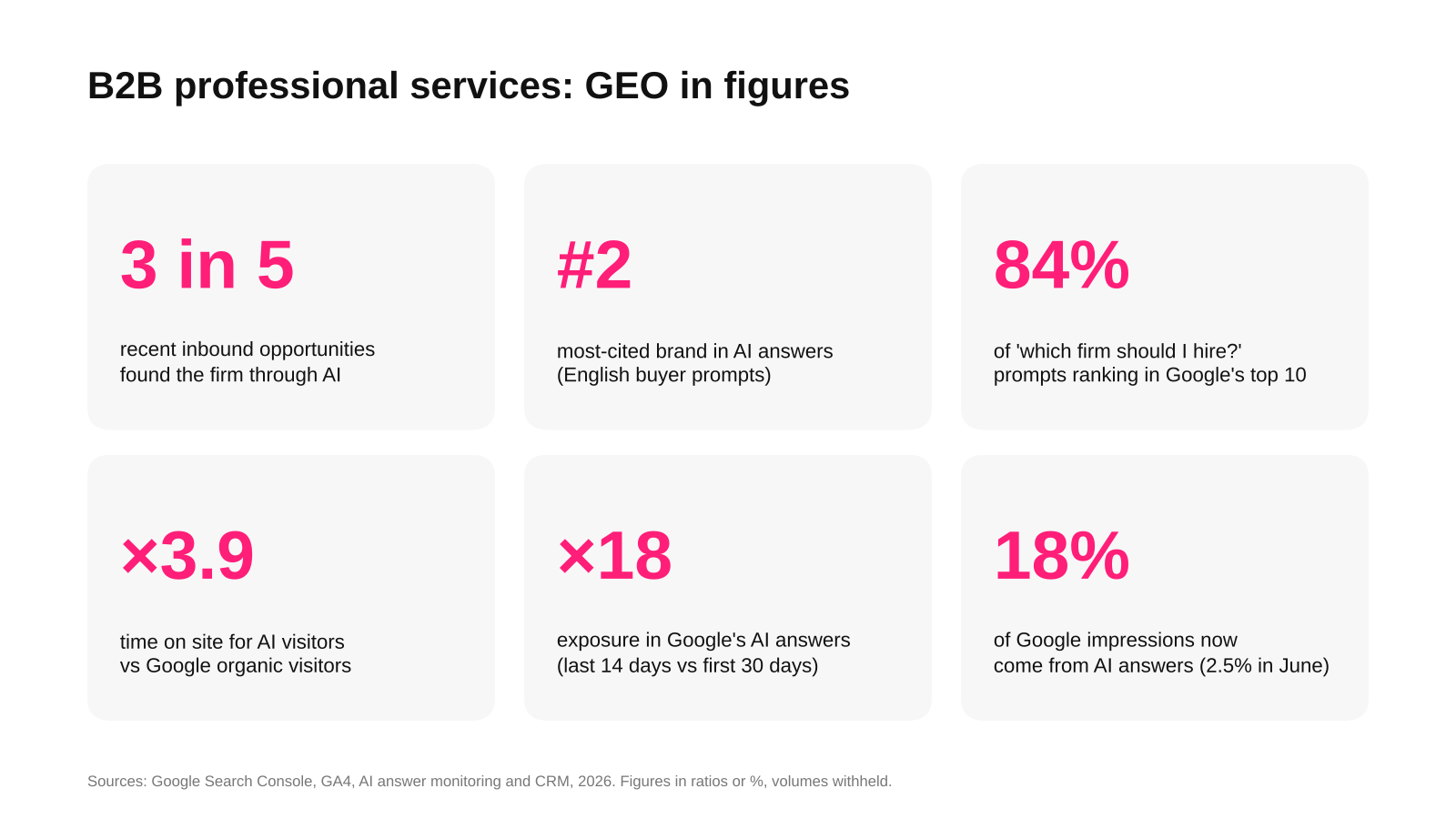
The firm had the expertise, the references and a decade of content. What it lacked was visibility where its buyers now search: in AI answers. We rebuilt the site on its existing equity and organised it for generative engines. Four months later, nearly one Google impression in five comes from AI Overviews and AI Mode, the firm ranks in the top 10 on 84% of the conversational prompts used to shortlist a provider, it is the second most-cited brand in AI answers to English buyer prompts, and three of its last five inbound opportunities came from prospects who found it through AI. First results, a few months in: the work continues and results keep improving. A follow-up will be published.
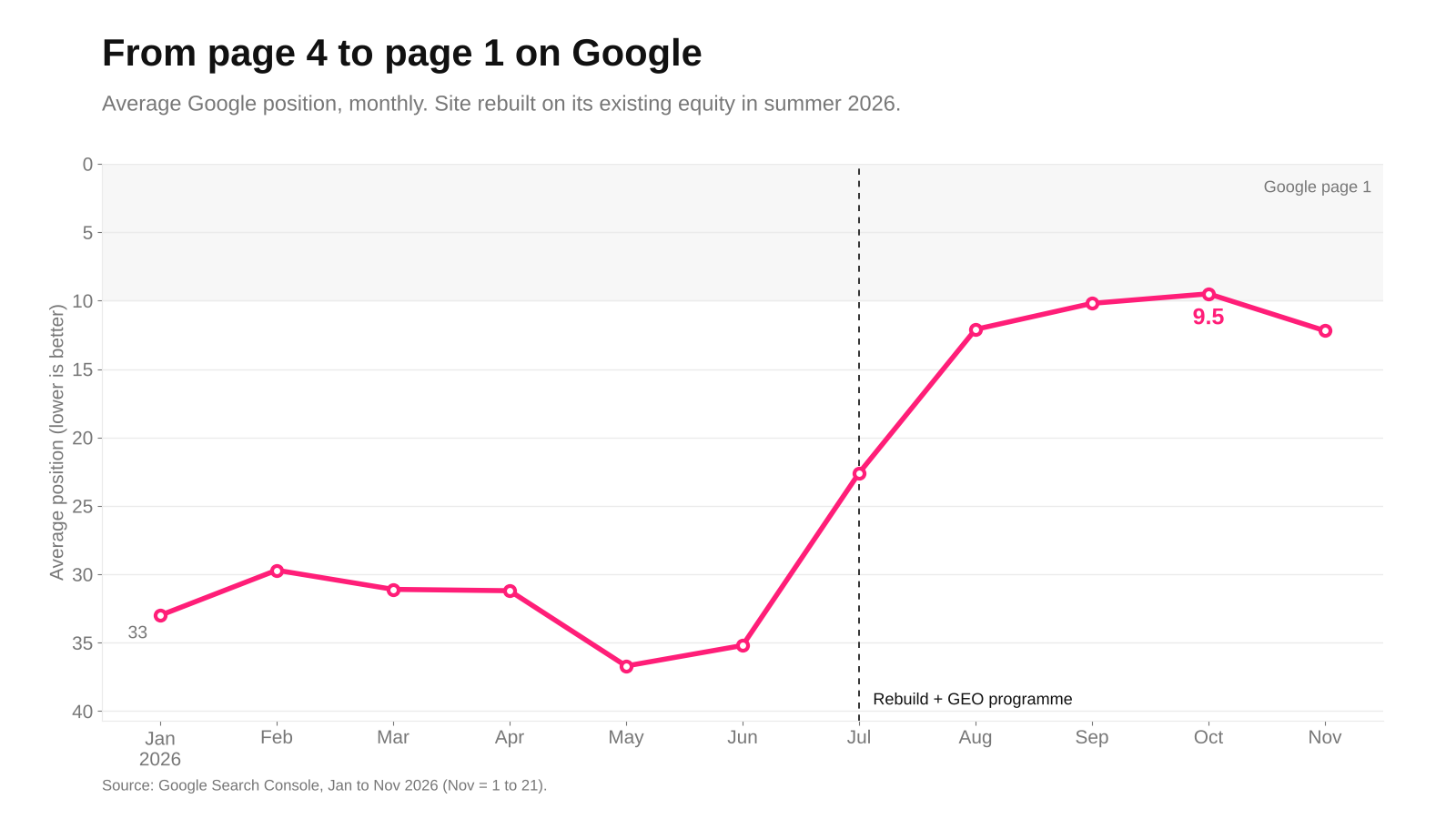
Active for about a decade, the firm had published expert content for years and counted large groups among its references. The equity was real; its visibility was not. In the first half of 2026, its average Google position hovered between 30 and 37: page 3 or 4, where nobody looks.
Meanwhile, the way B2B buyers search was changing. Questions now make up about one search in five, up from one in twelve in 20231. Buyers no longer type "consultancy Brussels"; they ask an assistant which firm to hire, and they get a shortlist. AI was threatening the firm's visibility at the exact moment of choice.
SEO is not dead; it has to be completed with GEO. Generative engines draw on years of SEO signals, so the first rule was to keep them: every historical page preserved or redirected, nothing discarded. On that base, we reorganised the site so that both Google and AI engines understand who the firm is, what it does and for whom.
SEO gets a site ranked; GEO gets a brand recommended. On top of the SEO foundations, we ran levers that only matter for generative engines.
Average position went from 35 in June to 9.5 in October, and keeps improving. The programme started only a few months ago: page 1 is a first milestone, not the finish line. Organic clicks were multiplied by 3.5 (September and October versus May and June).
Exposure in Google's AI answers was multiplied by 18 between the first 30 days measured and the last 14 days.

The share of the site's Google impressions generated by AI Overviews and AI Mode rose from 2.5% in June to 18% in November. Around a hundred pages now surface in AI answers, including articles written in 2018: proof that past equity keeps paying when it is made readable for generative engines.
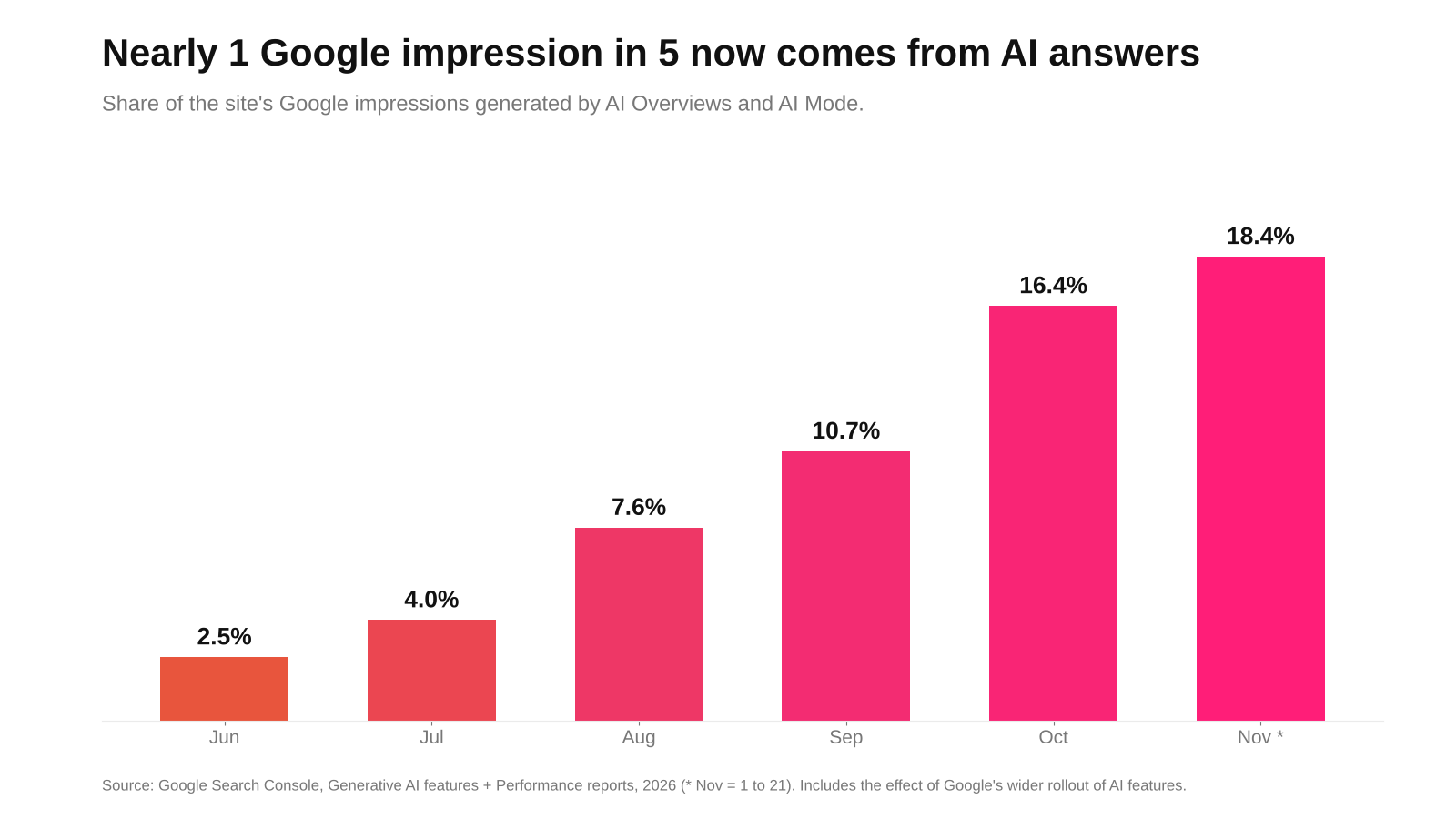
To be fair about the market effect: part of this growth is not ours. Google keeps extending AI Overviews and AI Mode to more queries, and users adopt them, by choice or by default. Any site's AI exposure rises with that tide. What the market does not give for free is the rest: being the source that gets cited, being named ahead of competitors on the buyer's own questions, and turning that presence into qualified leads. That is where the work shows.
The strongest signal is on intent. On the long, conversational prompts buyers use to choose a provider ("which firm should we work with for...", "who can help us with..."), the firm ranks in Google's top 10 on 84% of them, at an average position of 6.3.
GEO is not only about the site ranking; it is about the brand being named. We track a panel of 40 buyer prompts, in English and French, across the main AI assistants every week.
Visibility only matters if it brings business. It does. Over the last two months, three of the firm's last five inbound opportunities came from prospects who found it through ChatGPT or AI search, including an established international brand. These are not clicks or impressions: they are qualified requests that led to proposals.
Visitors arriving from AI assistants also behave differently: they spend nearly four times longer on the site than Google organic visitors. They arrive pre-qualified, having already read a recommendation.
Here, the first movement was visible within weeks of the rebuild and became clear after three to four months. It depends on the equity you start from: the more trusted content you already have, the faster engines pick it up.
Not always. A rebuild was the right moment here, but most of the gains come from structure, entity clarity and answer-first content, which can be applied to an existing site.
Yes. Google Search Console reports impressions in AI Overviews and AI Mode, and conversational queries can be isolated. AI referrals are tracked in analytics.
With a fixed panel of buyer prompts, run every week across the main assistants: how often the brand is named, in which position, and which sources the AI relies on. Averages over several weeks matter more than any single run, which can fluctuate.
Here, yes: within two months of the programme, AI search became the first source of new inbound opportunities. The key is to ask every lead how it found you and to track AI as a separate source.
If your site has years of SEO equity and you want to keep it while building your GEO presence, book a call or get in touch.
Data: Google Search Console, Google Analytics 4, AI answer monitoring (40 prompts, weekly, from October 2026) and CRM, January to November 2026 (November: 1 to 21). Figures shown as ratios or percentages. 1 NP Digital, March 2026, 1,000 respondents.
Ready when you are
30 minutes. No pitch deck. Just an honest conversation about where you are and where you want to go.
A project in mind? Let’s talk.

Belly for instinct, Brain for evidence. A digital & marketing consultancy for startups, SMEs and large groups, in Belgium and abroad.
Follow us on LinkedIn