An established French-language publisher in a health-adjacent niche, with strong SEO results and years of how-to guides: exactly the content AI Overviews answer without a click. The goal was to grow the newsletter. We restructured the catalogue for generative engines: newsletter signups doubled year on year, exposure in Google's AI answers multiplied by 14, and organic clicks held while the market went zero-click.
Informational content is the first casualty of AI Overviews. This publisher turned that threat into growth: its guides now feed Google's AI answers on virtually every topic it covers, and its newsletter, the business objective, signs up twice as many readers as a year ago.
At a glance
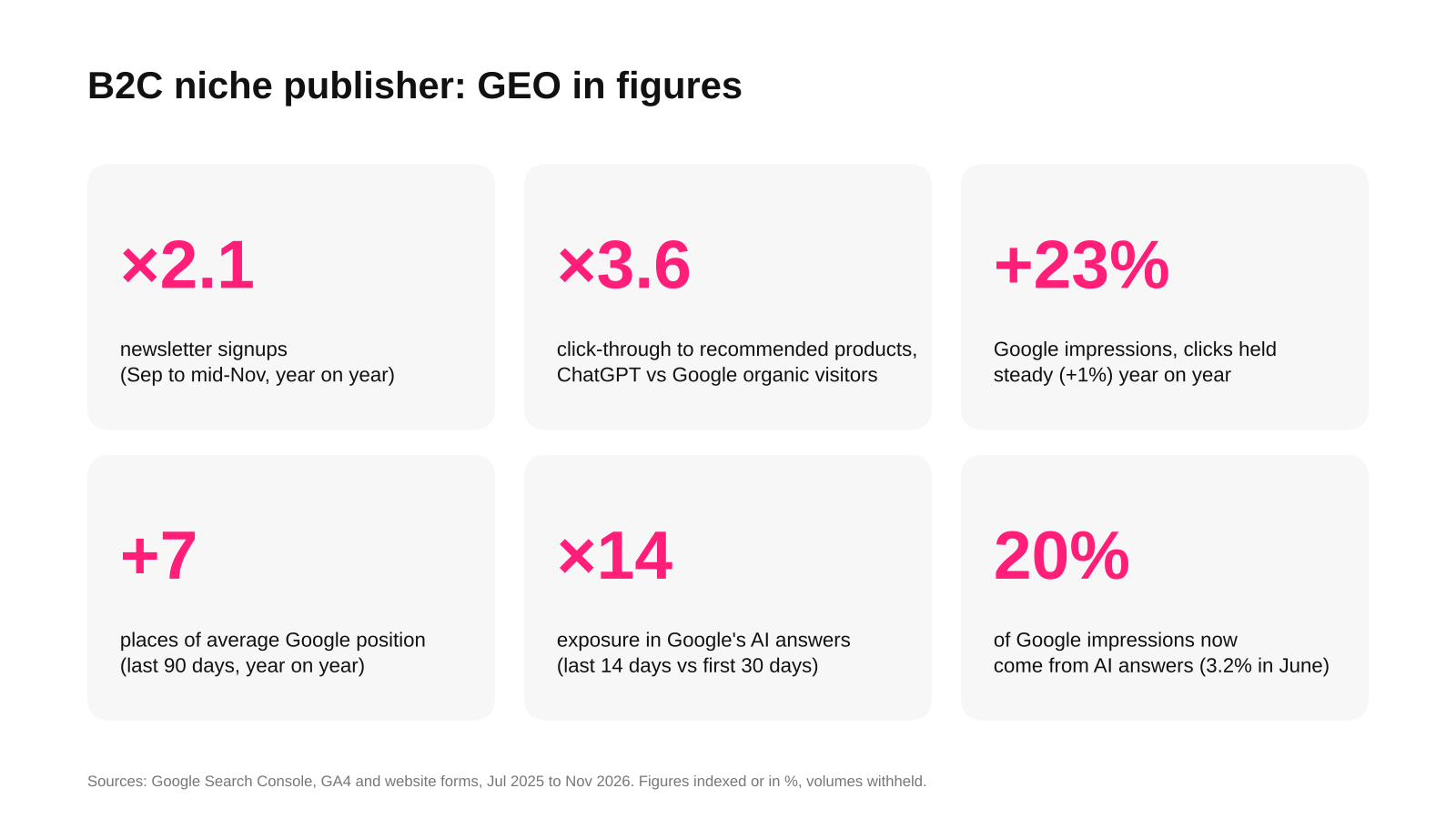
A specialist B2C publisher with strong SEO results and a catalogue of practical guides built over several years saw AI threaten its visibility: how-to questions are precisely what generative engines answer on the results page. We restructured the catalogue answer-first, with one objective: newsletter signups. They doubled year on year, exposure in Google's AI answers was multiplied by 14 in six months, AI now generates one Google impression in five, and visitors arriving from ChatGPT click through to recommended products 3.6 times more often than Google organic visitors. First results; a follow-up will be published.
The publisher had built a loyal audience and a catalogue of around 150 in-depth guides in a health-adjacent niche, monetised through a newsletter and affiliate recommendations. The newsletter is the core asset: it turns occasional readers into a loyal audience. Its SEO was already a success story: organic clicks multiplied by ten between summer 2023 and summer 2025, built on classic SEO well before the generative wave. Many pages still sat around position 20, the edge of page 2.
The risk was clear. 64% of Google searches now end without a click1, and practical questions ("how do I...", "what is the best remedy for...") are exactly what AI Overviews answer directly. Doing nothing meant watching the guides be summarised by others, and readers never reaching the site, let alone the newsletter.
If the answer stays on the results page, the goal becomes being the source of that answer. We kept that SEO equity intact and reworked the catalogue so generative engines could extract, trust and cite it.
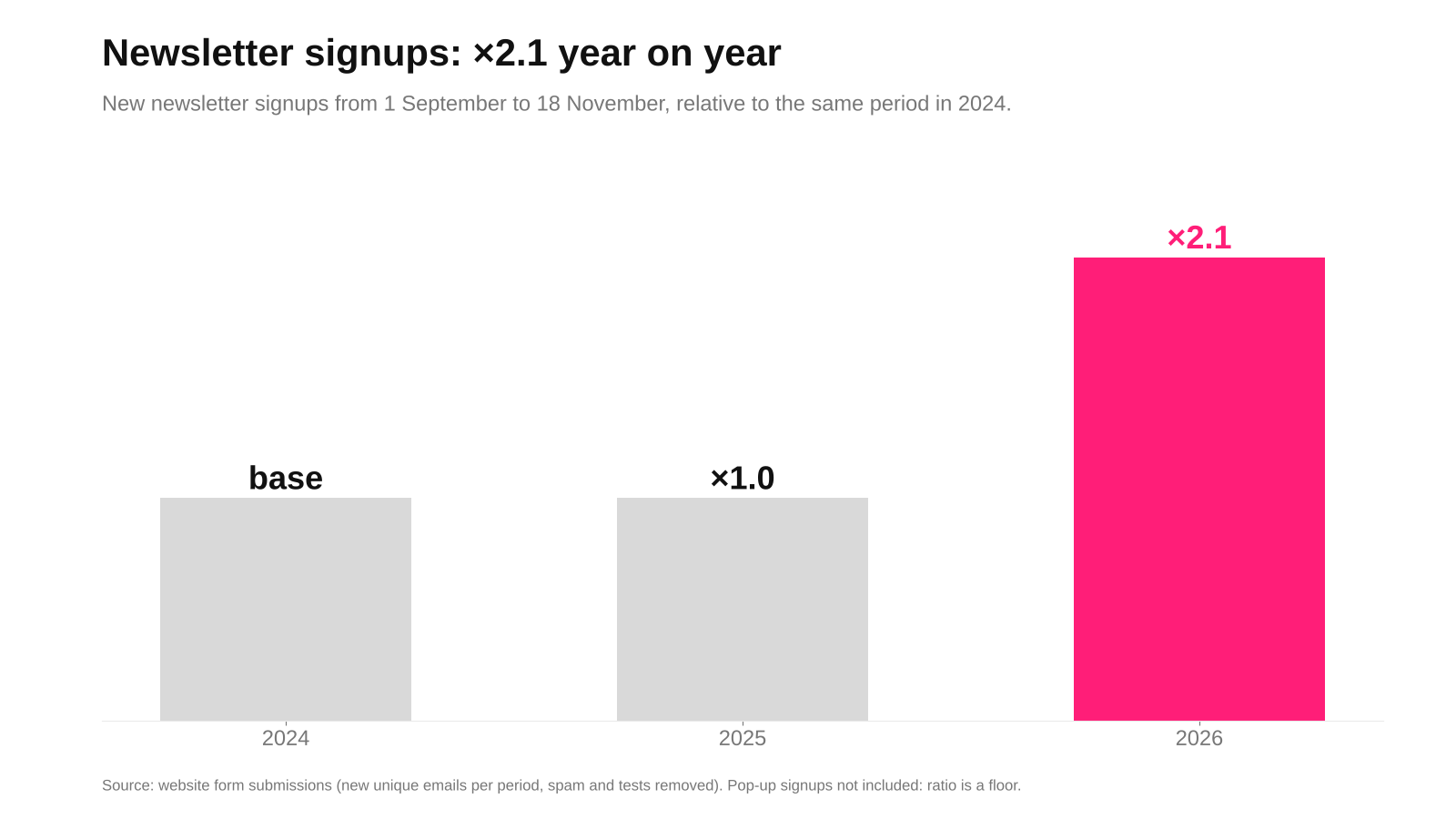
The objective is met: newsletter signups doubled. From September to mid-November, the site recorded 2.1 times more signups than over the same period in 2024 and in 2025, both flat. November 2026 is on track to be the best month since signups have been recorded.
Exposure in Google's AI answers was multiplied by 14 between the first 30 days measured and the last 14 days.

The share of the site's Google impressions generated by AI Overviews and AI Mode rose from 3.2% in June to 20% in November. Virtually the entire indexed catalogue now surfaces in AI answers, led by the most structured guides.

To be fair about the market effect: part of this growth is not ours. Google keeps extending AI Overviews and AI Mode to more queries, and users adopt them, by choice or by default. Any site's AI exposure rises with that tide. What the market does not give for free is the rest: being the guide the AI chooses to quote, holding clicks while others lose them, and doubling newsletter signups. That is where the work shows.
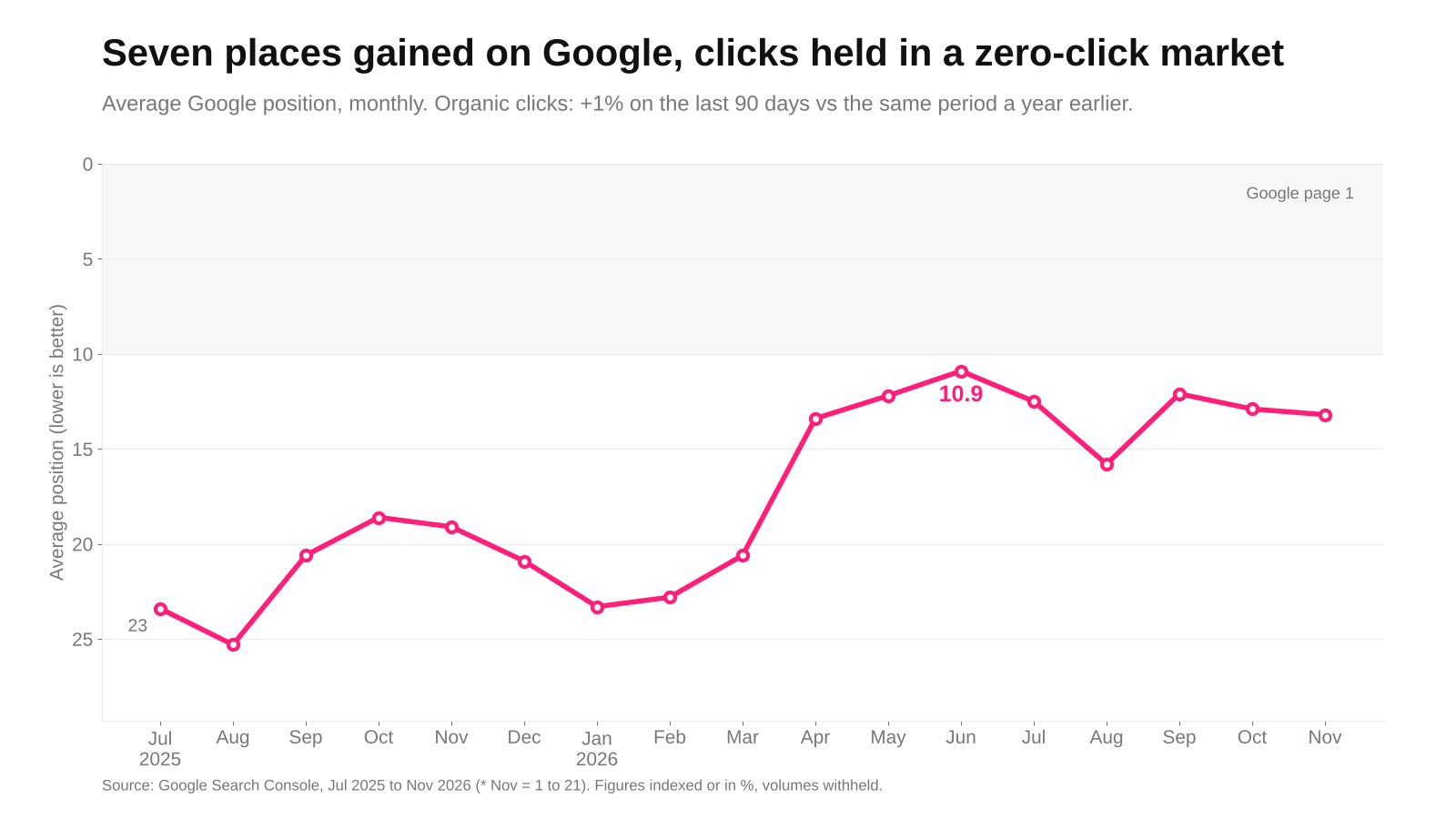
Classic SEO strengthened at the same time. Over the last 90 days, compared with the same period a year earlier, the average position improved by seven places (from 19.9 to 12.9) and impressions grew by 23%. Organic clicks held steady (+1%) in a market where clicks are shrinking: AI exposure added reach without cannibalising traffic.
The first AI referrals confirm the quality of that reach. Visitors now arrive from five different assistants, and those coming from ChatGPT click through to recommended products 3.6 times more often than Google organic visitors. The base is still small; the signal is consistent with market studies on AI traffic.
Not necessarily. Here, organic clicks held steady while AI exposure grew sharply. Sites that become the cited source keep their visibility; the others get summarised.
A direct answer, self-contained passages, clear structure, explicit sources and structured data. Generative engines favour content they can extract and trust.
Yes. Volumes are still modest, but these visitors act more and show which content AI assistants recommend.
If your guides deserve to be the source of AI answers, and you want to keep your SEO equity while building GEO, book a call or get in touch.
Data: Google Search Console (from 2023 for the SEO history), Google Analytics 4 and website form submissions, July 2025 to November 2026 (November: 1 to 21). Figures shown as ratios or percentages. 1 NP Digital, February 2026, 1,000 tracked searches.
Ready when you are
30 minutes. No pitch deck. Just an honest conversation about where you are and where you want to go.
A project in mind? Let’s talk.

Belly for instinct, Brain for evidence. A digital & marketing consultancy for startups, SMEs and large groups, in Belgium and abroad.
Follow us on LinkedIn